INVESTIGATION| How pro-Biafrans silently built current force

When in the 90's
an Okigwe, Imo State born Indian trained lawyer named Ralph Uwazuruike
started a rather tongue twisting organization called Movement for the
Actualization of the Sovereign State of Biafra (MASSOB), even those who
believed in what he was doing found it uncomfortable openly mentioning
the Biafra in MASSOB: as far as the Nigerian establishment was
concerned, that word with whatever it symbolized was dead and buried,
perhaps never to resurrect. But, it says a lot about the ability of the
Nigerian State to solve the socio-political, even existential, problems
that confront it that some 20 or so years after Uwazuruike's MASSOB was
formed, Biafra has become front page news again in Nigeria. OFFOR
ONUKWUWE reports that the path to this movement was paved with patience,
hard work and perseverance.
Origins The
recent struggles for Biafra started with Chief Ralph Uwazurike, who
formed MASSOB, Movement for the Actualization of the Sovereign State of
Biafra in the late 1990s. Although Uwazurike sought a pacifist path to
achieve Biafra, a new movement arose to address the loopholes found in
MASSOB, which most pro-Biafrans refused to embrace because they felt
that it was being hugely manipulated by Uwazurike for personal
interests.
Branches The many
composite organisations working for the emergence of Biafra did not
start in one day. Each of these groups was formed by its leaders, who,
finding their goals similar to other groups', decided to work with them.
Organisations like Bilie Human Rights Initiative (BHRI), Biafra
Zionists Movement (BZM), Biafra Restoration Movement (BRM), Indigenous
People of Biafra (IPOB), Biafra Organisation of Freedom Fighters (BOFF),
and Biafra Council of Elders (BCOE) are just a few of the groups who
have joined Chief Ralph Uwazurike's MASSOB in the fight for self
determination.
Despite the
overwhelming popularity of Radio Biafra today, an array of other media
outfits have been working like RB and they include Biafra 24, Biafra
Radio, Voice of Biafra, Ekwenche, Biafra Voice International, Biafra TV,
Biafra Herald and Biafra News Network.
According to
Madam Eberechukwu Anigboogu, former Women Leader of IPOB worldwide, the
organisations actually decided to unite in 2012 at a meeting in London
to work together as a unit. IPOB became a common front for the pursuance
of their goals. It was also in 2012 that
IPOB and Radio Biafra got
their registration in London to function within the tenets of law.
The Biafra
Council of Elders plays an advisory role to the other branches, who
would always return to the Council to give account of their activities
periodically.
Bilie Human
Rights Initiative (BHRI) is the legal and human rights arm which files
suits to pursue a legal means towards achieving the freedom for which
the organisation was formed.
Ekwe Nche is a
research institute formed in Chicago by pro-Biafran intellectuals. It is
a not-for profit organization committed to research in Igbo history and
culture and to the re-establishment of Igbo sovereignty through
peaceful means. Ekwe Nche is a term in Igbo which means "clarion call."
The organization is engaged in a wake-up call to Igbos in Nigeria to
rise up to the challenge of Igbo oppression in the country and to the
Igbo nation worldwide to recognize and live up to their Igbo heritage.
Ekwe Nche is made up of Igbos and their descendents from all parts of
the world, including the U.S., Cuba, Jamaica, the West Indies and other
Caribbean countries, and Nigeria. It was formed in 1996.
Style The IPOB
had designed a very comprehensive system of government which they hope
to put into use if Biafra is realized. They termed it Ohacracy. A whole
book has been written on the Ohacratic system of government. Termed
Ohacracy: The undercurrent of Africa centered nationalism and written by
Chukwudi Okeke-Maduno, the book defines Ohacracy and recommends it as a
better ideal to western democracy, which it sees as a crude form of the
natural and older ohacracy, which is natural to Africa and Africans.
According to
Osondu Iroegbu in his book, A Plea for Ohacracy, Ohacracy is the
practical conception of societal order and governance in which the
community determines the praxis of the socio-political life of the
people, while taking into account basic individual and group
peculiarities. The term Ohacracy is derived from the Igbo term oha,
meaning community, assembly, and the suffix cracy, (kratêein, to rule,
govern, organize) as in democracy.
Ohacracy
etymologically defined means rulership by the Oha, the community
members. Ohacracy is democracy in an African context. In other words, it
is the viable African species of contemporary institutional democracy.
In it, followership is as important as leadership. In it, leadership is
neither a one-man show nor a matter of hierarchical or aristocratic
machination. In it, there is the solidarity of decision and
implementation of decisions by the members in matters that affect the
members. In it, the Oha is the central focus. The Oha is a community of
individuals and the individuals are individuals in Oha. Oha nwe madu"The
community owns the individual." Ohakwe if the community allows. Each
nation in Africa forms the locus of an Oha.
"Specifically, it
takes into account the African identity and values," the book further
eplains. "It builds on African experience: its history, circumstances
and contemporary situation. It is a realistic articulation in view of a
positive future. This is why Ohacracy defines the modus operandi of
socio-political life: that the community sets out how we govern
ourselves. All forms of dictatorship, military rule or dominion by a
group, class or region is automatically ruled out.
All will agree that
it is only those we have chosen ohacratically who will govern us.
Anybody that is not chosen by us must go. It also determines the modus
vivendi of our communal life: that the basic individuality of the
persons shall be respected.
"The basic
individualities are those givens of each person (ends, duties and
rights, e.g., choice of profession), that make a person flourish.
Particular talents and group values like language, cultural artifacts
and socio-moral values have to be integrated within the general run of
communal development. These, however, must not threaten the existence of
the community as community. The individual will grow and develop, but
in community."
Activities Every
year, since 1999, all pro-Biafrans across the world hold a memorial
service in honour of those who died during the war as well as those who
are killed during demonstrations. The event, aptly termed "Biafra
Memorial Day" holds every May 30 and has gained resounding popularity as
thousands of people march the streets of major cities in the world.
Anigboogu told The Authority that the Memorial started in 1999 in Lagos, with MASSOB.
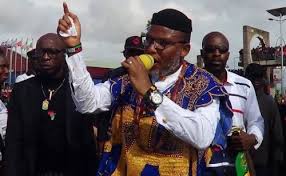
Nnamdi Kanu, who
is the director of Radio Biafra in an earlier interview told our
correspondent that over 60 million families constitute pro-Biafrans
organisations, scattered across some 88 countries the world over.
The Memorial Day
is an addition to the civil disobedience, which holds periodically. This
was also instituted by MASSOB, where pro-Biafrans are told to stay away
from their businesses to show that they are not happy with the
government of Nigeria. They usually obey.


No comments